For most karting families, there comes a moment at the club track when someone says it.
"He's winning here. You should take him national."
It's a huge compliment, and it's an exciting thought. But national karting is a very different world from club racing, and it's worth going in with your eyes open.
We've done both. Zak started in club racing at Bayford Meadows, winning club races there and at Hunts Kart Club, and in 2024 took wins and plates at club level, including the Red Lodge O Plate and the Bayford Meadows BM Plate. That same year he made his first national step in the Ultimate Karting Championship (UKC), racing in the Inter class with LMM Motorsport and finishing 14th overall.
Since then he's raced nationally in The Kart Championship (TKC), finishing 5th overall with multiple podiums in 2025 as a factory X-Kart driver, and in the 2026 Super One Series, plus winter series and plate events. In 2025 he also represented the UK at the TB Kart World Finals in Paris, finishing inside the top ten.
We've had the highs, like that P5 overall in TKC and charging from 18th to 4th at Clay Pigeon. We've had the lows too: a disqualification, a written-off chassis, injuries and weekends where nothing went right.
Here's our honest take on the advantages and the downfalls.
What counts as "national" racing?
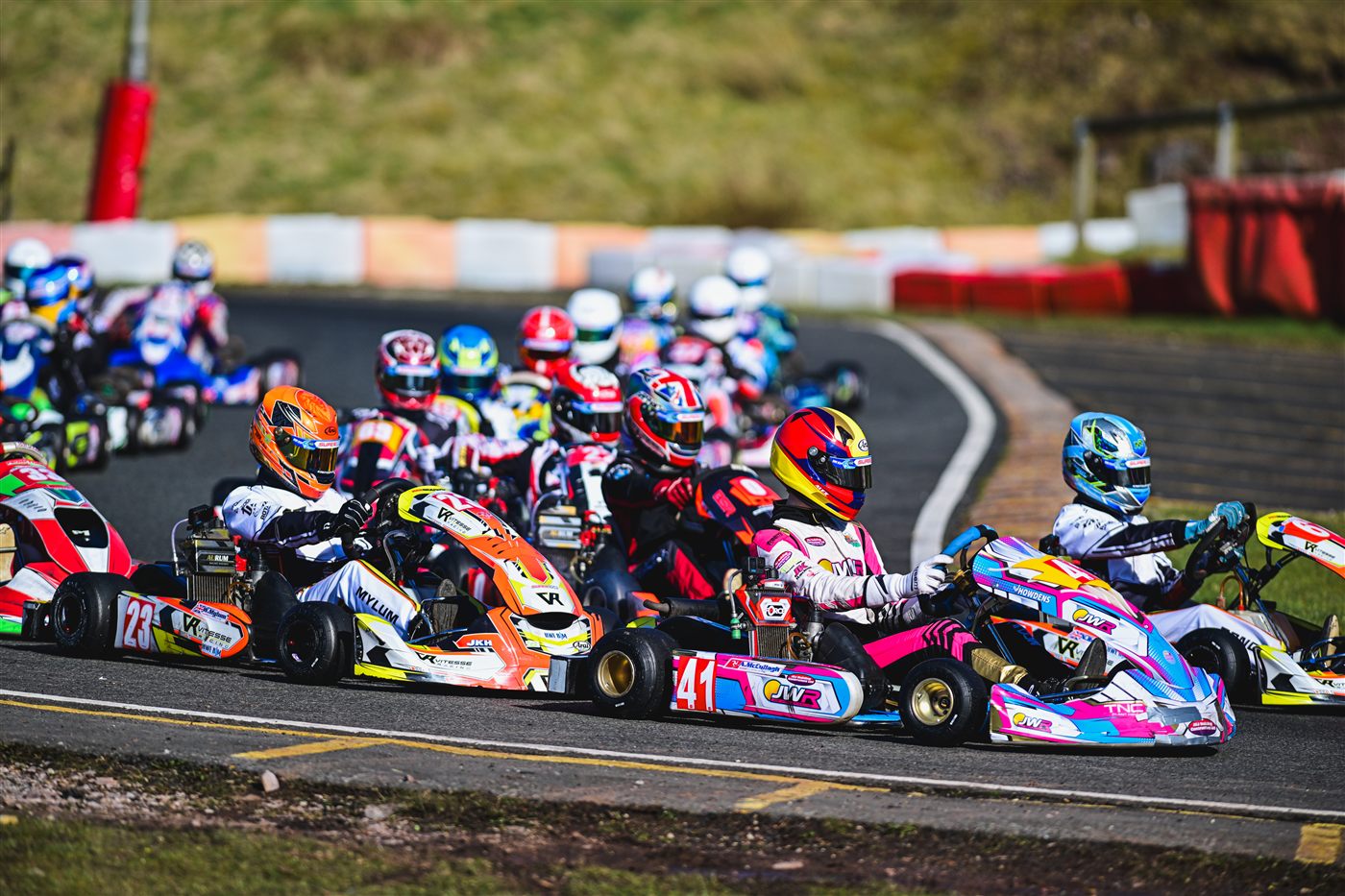
Club racing is your local kart club's championship, usually at one circuit, once a month. National championships travel to different circuits around the country and attract the best drivers from across the UK. The main ones include:
- Motorsport UK British Kart Championships, where official British champions are crowned
- Super One Series, one of the longest-running national series
- The Kart Championship (TKC)
- National Kart Cup (NKC)
- Ultimate Karting Championship (UKC), a route to the Rotax MAX Challenge Grand Finals, and where Zak had his first national season in 2024
See our full UK karting championships guide for classes, venues and the rest of the calendar.
You'll need the right licence
Most national championships run at National status, which means your driver needs a Kart National licence. Under Motorsport UK's rules, you upgrade from a Kart Interclub licence by collecting 10 race signatures from at least 3 different venues (passing the ARKS test counts as one). So a season of club racing, with a few visits to other tracks, is the natural first step anyway. Always check the championship regulations for exact requirements.
The advantages of racing national
The competition makes you better
This is the biggest one. At club level, a quick driver can spend a season winning by several seconds and learn very little. At national level, the grids are bigger and deeper, and the gaps are tiny. Hundredths of a second can separate a row of the grid. Your driver learns to qualify under pressure, race wheel to wheel with the best in the country, and find every last bit of time.
Racecraft, and lots of it
Big national grids mean close racing from the first corner to the flag. Drivers learn when to attack, when to defend and when to settle for a result. That racecraft is exactly what car teams, coaches and scholarship panels look for.
New circuits every round
Instead of mastering one home track, drivers have to learn Rowrah, Shenington, Whilton Mill, PFI, Glan-y-Gors, Clay Pigeon and more, quickly. Adapting to a new circuit each round is a skill in itself, and it's brilliant preparation for car racing.
People are watching
National championships are where teams, manufacturers, coaches, scouts and sponsors pay attention. Many series are live-streamed, and TKC even features in the Driven Dreams TV documentary. For a young driver who wants to go further, or who needs to attract sponsors, that visibility matters.
A proper measure of where you stand
Winning at your home club tells you you're quick at your home club. A national championship tells you where your driver really stands in the country. That's valuable whatever you decide to do next.
The bigger stage and the pathway
National championships lead on to bigger things: the plate events, international races like the Rotax MAX Challenge Grand Finals through the UKC, scholarships, and eventually cars. In 2025, Zak represented the UK at the TB Kart World Finals in Paris. Most of the drivers who move up to car racing have national karting experience behind them.
The people
Some of our best friends in karting are families we've met in national paddocks, from all over the country. There's something special about seeing the same faces at a different circuit every month.
The downfalls
The cost goes up. A lot.
There's no getting away from it. National racing means higher entry fees, more tyres, more engine rebuilds, test days at circuits you don't know, and travel and hotels for almost every round. Published estimates of a season's budget look like this:
| Championship | Rounds | Estimated season budget |
|---|---|---|
| Super One Series | 12 | £8,000 to £22,000 |
| The Kart Championship (TKC) | 7 | £8,000 to £18,000 |
| British Kart Championships (IAME series) | 9 | £5,000 to £14,000 |
| Champions of the Future Academy | 4 | £2,500 to £5,000 |
Source: MyRacingPath, Best Karting Championships in the UK (2026). Budgets vary hugely with class, testing and whether you own or hire.
Be warned: those figures are the lower end of reality for many families. If you run with a team at national level, our own experience is that a race weekend can easily cost £2,000 to £3,000 or more once awning space, a mechanic, engine hire, entries, tyres and damage are added up. We break that down in Privateer or race team?
Travel and time
National rounds are spread across the country. If you live in Kent, Rowrah in Cumbria is a very long drive. Many rounds need a Friday practice day, which means a day off school and work, two or three nights away, fuel, hotels and food. Some families spend more time on the motorway than on the track.
Less seat time for your money
For the cost of one national weekend, you could often do several club meetings or test days. Early in a driver's career, seat time is everything, so moving up too early can actually slow development.
It can be brutal on the results sheet
A driver who wins at club level can find themselves at the back of a packed national grid. Qualifying curses, repechage races, being taken out on lap one, penalties and disqualifications for things you didn't know about all happen. We've been through all of them. For a young driver used to winning, that can be a real knock to their confidence, and parents need to be ready for it.
More crashes, more damage
Bigger, closer grids mean more contact. Damage bills climb, and so does the risk of injury. We've had a rib injury end a Rowrah weekend before the final, and a crash that triggered the Motorsport UK concussion rule and cost us a championship position. A good rib protector and neck brace aren't optional extras at this level.
The spending arms race
At national level, some families test every week, run new tyres constantly and have a team behind them. It's easy to feel you have to match them. That's how budgets spiral, and how karting stops being fun.
Pressure on the whole family
Long weekends, big bills and high stakes can put strain on everyone: the driver, the parents and brothers and sisters who get dragged along. It's important to keep checking that everyone is still enjoying it. Our mental health guide is worth a read.
Don't underestimate club racing
Club racing isn't a lesser version of the sport. It's cheaper, local, and gives far more seat time. Drivers race regularly at a track they know, build confidence, and can win. Many great drivers spent several seasons at club level before moving up, and plenty of families race club for years and love every minute.
There's also a middle ground: stay at club level for your main season and add a winter series, a one-off round or a plate event to get a taste of national competition without committing to a full season.
Are you ready for national racing?
- Is your driver consistently at the front at club level, and in more than one circuit's club?
- Do you have (or are you close to) a Kart National licence?
- Have you budgeted for the whole season, including testing, tyres, rebuilds, travel and damage, not just the entry fees?
- Can the family commit to the weekends away, including Fridays?
- Does your driver actually want it, or is it the parents?
- Are you prepared for results to get worse before they get better?
If you can say yes to most of those, national racing can be one of the best things you ever do together.
Our tips if you're making the step
Try before you commit
Do a winter series, a single round or a plate event first.
Pick one championship
Chasing two national series at once doubles the cost and the travel. Do one properly.
Test at the circuits
A test day at each new track before the round makes a huge difference.
Budget for the season, then add a contingency
Damage, a dead engine or an extra set of tyres will happen.
Set realistic goals
For a first national season, making finals, improving qualifying and learning every circuit are big achievements.
Keep it fun
If it stops being fun for your driver, it's time to step back.
Our honest take
National karting has given Zak some of his best moments and some of his toughest. It made him a far better, more resilient driver, and it's opened doors for his move into cars. But it's also cost us a lot of money, a lot of miles and a few tears.
Don't rush it. Get the seat time at club level, build the budget, and go national when your driver is ready, not when the paddock tells you to.
Want to see what it's really like? Watch our TKC 2025, TKC 2026 and Super One 2026 vlogs, where we show every high and low.
Sources: MyRacingPath, Motorsport UK and the Motorsport UK National Competition Rules (licensing), plus our own seasons of national karting.