
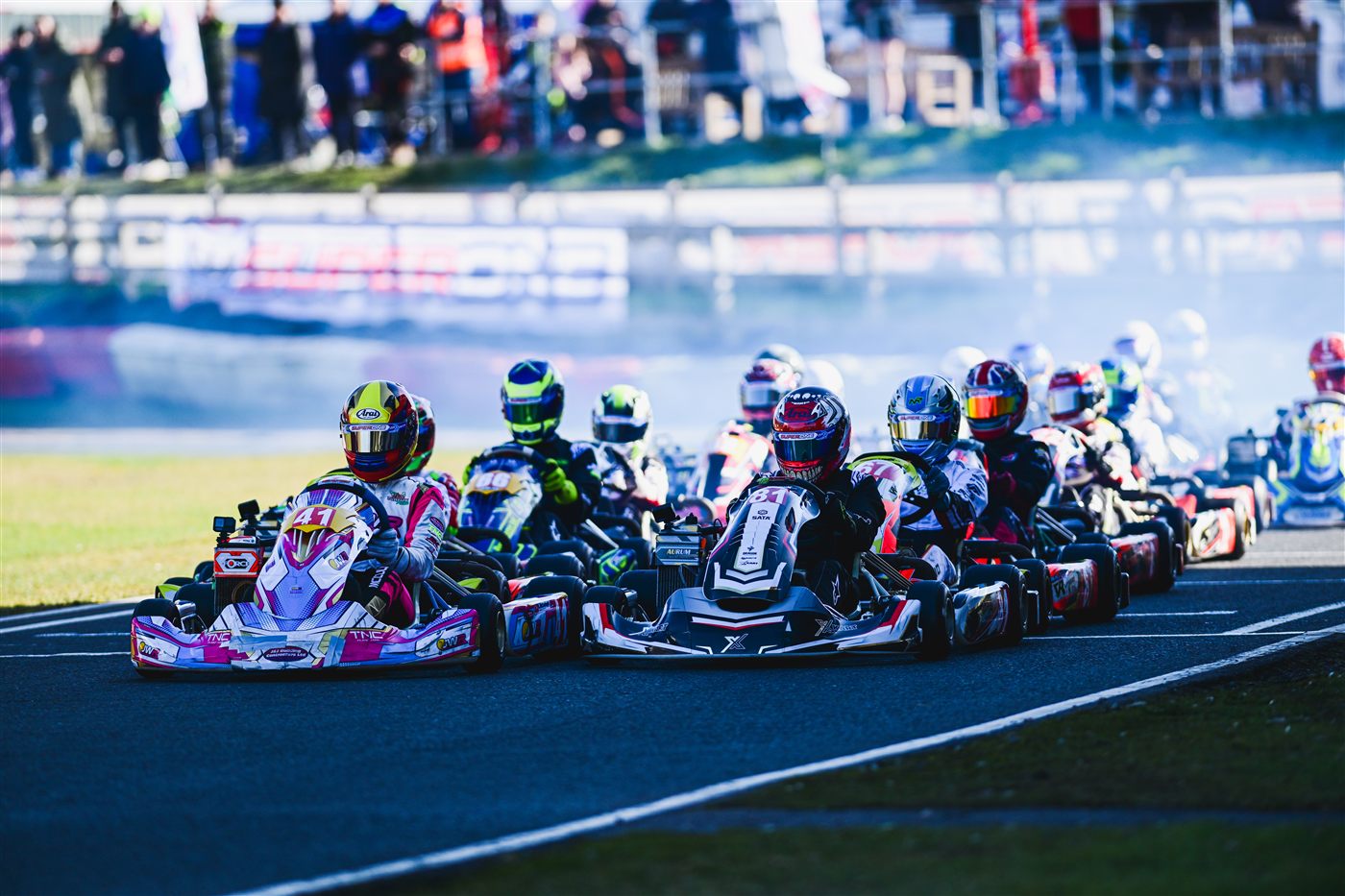
Spend enough time around a karting paddock and eventually you will hear it.
"He's going to be the next Lando Norris."
"She could go all the way."
"That kid is definitely going to Formula 1."
There is absolutely nothing wrong with dreaming.
In fact, dreams are a huge part of junior motorsport. They are what get families out of bed at ridiculous times on a Sunday morning, what keeps drivers going after difficult weekends and what makes children want to improve every time they get behind the wheel.
But there is also a point where parents need to understand exactly what the Formula 1 dream involves.
Because being quick in a kart is only the very beginning.
Being fast is not enough
One of the biggest misconceptions in junior motorsport is that if a young driver is talented enough, somebody will eventually notice them and pay for everything.
Unfortunately, it rarely works like that.
Talent is incredibly important, but so are results, timing, relationships, commercial value, opportunities and, perhaps most importantly, money.
Your child isn't simply competing against the drivers standing beside them on the grid at their local circuit.
They are competing against young drivers from across Europe, Asia, North America, South America, Australia and the Middle East.
Many of those children have been racing since they were five or six years old.
Some are testing almost constantly.
Some are competing in several championships at the same time.
And some have families, sponsors, academies or investors capable of spending extraordinary amounts of money developing their careers.
That doesn't mean a driver without enormous wealth cannot succeed.
But pretending the financial side doesn't matter doesn't help anyone either.
How much does the road to Formula 1 actually cost?
There is no single figure.
Every driver's journey is different.
Some drivers move through categories quickly. Others spend several seasons at one level.
Some secure manufacturer or academy support.
Some have sponsors.
Some families fund almost everything themselves.
Some drivers need extensive private testing, while others require less.
Accidents and mechanical failures can also completely change a season's budget.
However, the overall numbers involved are staggering.
That should probably stop most karting parents in their tracks for a moment.
And when you start looking at the individual stages, you can understand why.
Karting: where the spending begins
Karting is often described as the cheapest part of the motorsport ladder.
That statement tells you almost everything you need to know.
At club level, karting can still be relatively accessible compared with car racing.
But once families start chasing major national championships, European events and international competition, costs can increase dramatically.
Engines, chassis, tyres, testing, mechanics, team fees, travel, hotels, flights, entry fees and damage all start adding up.
A serious national karting programme can run well into tens of thousands of pounds each year.
At the very highest levels of international karting, yearly budgets can reach six figures and beyond.
And remember, this is happening while drivers are often still only children.
Formula 4: the first major jump
For many young drivers, Formula 4 is the first serious step from karting into single-seater car racing.
It is also where families can experience an enormous financial shock.
A properly funded competitive F4 season can cost somewhere around £500,000, depending on the championship, team, testing programme and additional expenses involved.
There are cheaper routes and championships, but if the objective is the traditional international Formula 1 ladder, families generally want strong teams, extensive testing and competitive machinery.
Suddenly you are no longer talking about finding £20,000 or £30,000.
You are potentially trying to find hundreds of thousands of pounds for a single racing season.
And there is no guarantee of success.
Formula Regional
If a driver progresses beyond Formula 4, another major financial hurdle arrives.
Formula Regional sits between F4 and FIA Formula 3 and is another important development step for many drivers following the single-seater route.
Budgets can approach or exceed £1 million for a season when testing and other costs are included.
At this stage, the competition is becoming increasingly international.
Many of the drivers have already won major championships.
They aren't simply good drivers anymore.
They are some of the best young drivers in the world.
FIA Formula 3
Then you reach FIA Formula 3.
This is where the Formula 1 paddock really starts getting close.
F3 races on Formula 1 weekends and drivers are competing directly in front of F1 teams, academies and decision makers.
A season can cost around £1.5 million, depending on the programme.
Again, that is for one season.
And even after spending that money, a driver could finish outside the championship positions needed to attract serious attention.
Motorsport does not refund you because the season didn't go according to plan.
Formula 2
Formula 2 is generally considered the final major step before Formula 1.
The drivers are exceptionally talented.
Many already belong to Formula 1 junior academies.
Some are national champions, Formula 3 champions or highly rated prospects who have been developing their careers for more than a decade.
And the budgets are extraordinary.
Current estimates suggest an F2 season can cost somewhere around €2 million to €3 million, sometimes more depending on the team and programme involved.
That is potentially several million pounds across only two seasons.
And reaching Formula 2 still doesn't guarantee Formula 1.
| Stage | Rough cost |
|---|---|
| Serious national karting | Tens of thousands of pounds a year |
| Top international karting | Six figures a year and beyond |
| Formula 4 | Around £500,000 a season |
| Formula Regional | Approaching or over £1 million a season |
| FIA Formula 3 | Around £1.5 million a season |
| Formula 2 | Around €2 million to €3 million a season |
| The whole ladder | Around £8 million, "if you're lucky" |
Rough figures for a competitive season on the traditional single-seater route. Every programme is different.
There are only 22 Formula 1 race seats
This is perhaps the most important statistic of all.
There are currently just 22 Formula 1 race seats.
Twenty-two.
Across the entire planet.
Thousands of talented young drivers begin racing every year.
Hundreds will compete seriously at national and international level.
Dozens will eventually reach high-level single-seater racing.
Only a tiny number will ever race in Formula 1.
That doesn't mean you shouldn't try.
But it does mean parents need to understand the scale of what they are trying to achieve.
"Someone will spot them"
This is another phrase you hear regularly in karting.
"If they're good enough, someone will pick them up."
Sometimes drivers do receive substantial support.
- Formula 1 teams operate junior academies.
- Manufacturers support promising drivers.
- Scholarships exist.
- Sponsors can transform careers.
There are also occasions where individuals or businesses decide to financially support an exceptionally talented young driver.
But these opportunities are limited.
And importantly, most drivers have already spent enormous amounts of money before they receive that level of support.
Academies aren't usually walking around club kart meetings looking for a seven-year-old they can completely fund for the next decade.
Drivers generally have to prove themselves first.
And proving yourself costs money.
Parents can become obsessed with "the ladder"
There is another danger that doesn't get discussed enough.
The constant need to move upwards.
Cadets. Juniors. Seniors. European karting. Formula 4. Formula Regional. Formula 3. Formula 2. Formula 1.
There is always another championship.
Another team.
Another test.
Another opportunity.
Another £20,000. Another £50,000. Another £100,000.
Before long, families can become so focused on reaching the next level that they forget why they started racing in the first place.
Motorsport becomes less about enjoyment and more about survival.
Every result suddenly feels critical.
Every bad weekend becomes a disaster.
Every crash becomes another financial problem.
And enormous pressure can end up being placed on a child who originally started racing because they loved driving a kart.
Formula 1 does not have to define success
This is probably the biggest message I would give any family involved in junior motorsport.
Formula 1 is not the only measure of success.
Motorsport is enormous. There are professional careers in:
- GT racing
- Touring cars
- Endurance racing
- One-make championships
- Prototype racing
- Historic motorsport
- Rallying
- Coaching
- Engineering
- Race team management
- Media
- Sim racing
- Driver development
- Manufacturer programmes
There are also thousands of people who race simply because they love racing.
And there is absolutely nothing wrong with that.
A young driver could spend years competing in motorsport, make lifelong friends, race incredible cars, visit brilliant circuits and create memories with their family without ever going anywhere near Formula 1.
That isn't failure.
The question parents should ask
Instead of constantly asking:
"Can my child make it to Formula 1?"
Perhaps there is a better question.
That question changes everything.
It doesn't mean giving up ambition.
It doesn't mean settling for less.
And it certainly doesn't mean telling a talented child they shouldn't dream.
It simply means recognising that there has to be a balance between ambition, finances, family life and enjoyment.
- Give them opportunities.
- Help them improve.
- Push them when they need pushing.
- Support them when things go wrong.
- Allow them to dream as big as they want.
But don't allow Formula 1 to become the only acceptable outcome.
Because for virtually every young driver currently sitting in a kart, Formula 1 won't happen.
That isn't being negative.
It is simply the mathematical reality of elite sport.
Our own approach at Zenico Racing
This is something we are becoming increasingly aware of ourselves as we move from karting into cars.
With Zak making the transition into senior car racing, we aren't pretending that Formula 1 is sitting at the end of some predetermined pathway.
We don't know where the journey will lead.
And that is actually part of what makes it exciting.
Our focus is on helping Zak develop as a driver, gaining experience, making sensible decisions and seeing how far we can realistically take things.
We're also going to document that transition through Zenico Racing and our Karts to Cars journey, showing the things that often aren't discussed:
- The costs
- The testing
- The licences
- The equipment
- The mistakes
- The sponsorship
- The opportunities
- The difficult decisions
And hopefully the successes as well.
Because there are thousands of karting families approaching the same point and asking exactly the same question:
What comes next?
The answer doesn't always have to be Formula 1.
Sometimes the goal should simply be to keep moving forward.
Dream big, but keep perspective
Every child in motorsport should be allowed to dream.
Maybe your son or daughter really could become one of the exceptional few.
Nobody knows where talent, determination and opportunity might eventually take them.
But parents also have to remain realistic about the journey.
Don't destroy your family's finances because you feel you have to keep up with somebody spending more.
Don't convince yourself that one championship result will determine your child's entire future.
And don't become so focused on where you are trying to get to that you forget to enjoy where you are now.
There may only be 22 Formula 1 seats.
But there are thousands of other ways to enjoy motorsport.
And twenty years from now, your child may not remember every trophy, championship position or lap time.
They will remember the weekends away.
The laughs in the awning.
The disasters you somehow fixed.
The long drives home.
The friends they made.
And the fact that their family was there with them.